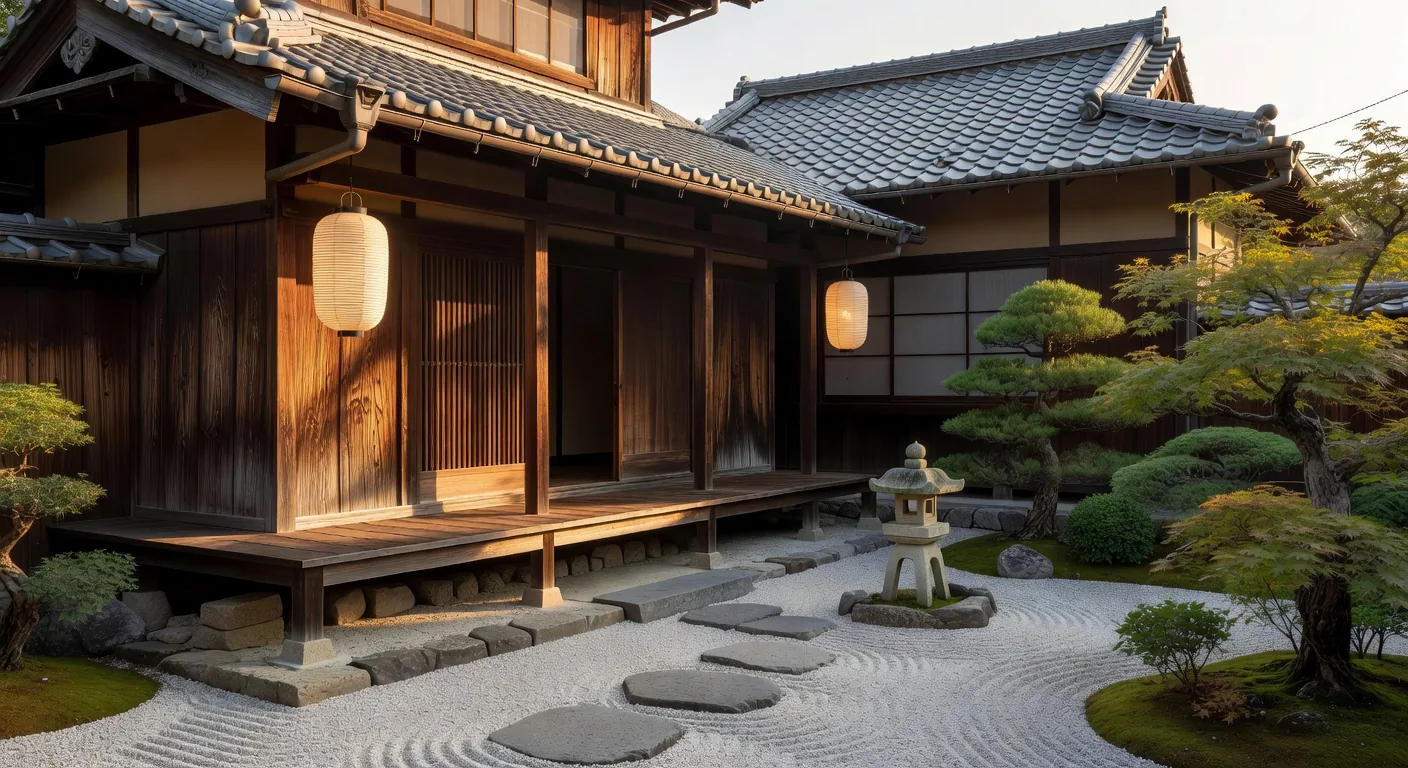
Japan has produced some of the world's most distinctive architectural traditions — from the interlocking timber joints of ancient shrines to the radical concrete experiments of its postwar masters. What unites them all is a profound sensitivity to material, light, and place.
To study Japanese architecture is to study a civilization's dialogue with nature, with impermanence, and with the challenge of building beautiful things in a land prone to earthquakes, typhoons, and seasonal extremes. Every solution Japan's architects have found has been shaped by these pressures — and it is this pressure that has produced such astonishing beauty.
Machiya
Traditional wooden townhouses, built for merchants along urban corridors since the Heian period.
Modernist
Japan's 20th-century masters — Tange, Maekawa, Sakakura — forged a new national architecture from concrete and philosophy.
Contemporary
Today's Japanese architects — Ando, Ban, Fujimoto — continue to push the boundaries of space, light, and material.
Machiya: The Living Townhouse Tradition
The machiya — literally "town house" — is one of Japan's most enduring and elegant building types. Built along the narrow commercial streets of Kyoto and other historic cities, these long, slender wooden structures solved a practical problem — high street-frontage taxes — with extraordinary ingenuity.
A typical machiya presents a narrow facade to the street — sometimes as little as four or five meters wide — but extends deep into the block, sometimes 20 or 30 meters. Organized around a series of small interior gardens (tsuboniwa), these courts brought light, air, and the changing seasons into the depths of the building.
The timber construction — post-and-beam frames filled with wattle-and-daub walls — was designed for flexibility rather than permanence. Rooms could be easily reconfigured by sliding panels. Buildings could be extended or divided. The machiya was not built to last forever but to adapt.
"The machiya does not stand apart from nature — it frames it, invites it in, celebrates the season through a window no larger than a scroll."
Today, machiya preservation has become a major cultural movement in Kyoto. Hundreds of these structures have been converted into cafés, boutique hotels, galleries, and restaurants — breathing new life into a building type that had faced extinction.
The Modernist Generation
Japan's encounter with Western modernism in the late 19th and early 20th centuries was not mere adoption — it was transformation. Japanese architects like Kenzo Tange, Kunio Maekawa, and Junzo Sakakura absorbed the lessons of Corbusier and Mies, but reframed them through deeply Japanese spatial sensibilities.
Tange's celebrated Hiroshima Peace Memorial Museum (1955) exemplifies this synthesis: the building is elevated on pilotis above a formal axis that frames the A-bomb dome in the distance, creating a sequence of spatial experiences that is simultaneously modernist in form and deeply Japanese in its approach to procession, threshold, and framing.
Contemporary Masters: Light, Concrete, and Wood
The generation of Japanese architects that emerged in the 1980s and 1990s achieved an unprecedented level of global recognition. Tadao Ando, Kengo Kuma, Toyo Ito, Shigeru Ban — each developed a distinctive architectural language rooted in Japanese sensibilities but legible across cultures.
Tadao Ando: Concrete and the Void
Tadao Ando's architecture is an architecture of contradiction: massive concrete walls that feel weightless; dark spaces that shimmer with light; enclosed courtyards that amplify rather than diminish one's sense of the sky. His Church of the Light in Osaka — a bare concrete box with a cross-shaped void cut into its eastern wall — concentrates natural light into an almost unbearable intensity. It is a room that makes you feel the religious experience of a beam of light falling on stone.
Kengo Kuma: The Return to Wood
Where Ando's generation embraced concrete, Kengo Kuma has led a powerful return to wood and other natural materials. His architecture attempts to "erase" the building — to dissolve its mass into texture, light, and landscape. The V&A Dundee museum in Scotland, designed by Kuma, wraps itself in stone fins that echo the region's cliff formations, demonstrating how deeply Japanese principles of material sensitivity can translate to any context.
Fujimoto and the New Generation
Sou Fujimoto represents an even younger generation — architects raised in a Japan that had both mastered and questioned modernism. His work explores ambiguity: buildings that are neither inside nor outside, neither cave nor nest. His Serpentine Pavilion (2013) — a cloud of thin steel rods that visitors inhabit like a fog — is architecture at its most philosophical: a structure that exists to question what a structure is.
"Japanese architecture has never been about the building alone. It has always been about the space between buildings — the threshold, the garden, the borrowed view of a mountain."
As Japan faces the challenges of its aging society, shrinking rural communities, and the need to reimagine its dense urban fabric, its architects continue to do what they have always done: find beauty and meaning in constraint, make poetry from the limits that the land and culture impose.